Reading Begins with Words

A reader can pronounce every word on a page and still miss what the page means. Reading requires more than decoding print; it also requires understanding language. Vocabulary connects these two processes, making it essential not only to reading comprehension but also to literacy more broadly.
Vocabulary is the store of words we understand and use. But knowing a word involves far more than memorizing its definition. It means recognizing the word in print and speech, understanding its different meanings, connecting it to related ideas, and using it appropriately. This depth of knowledge helps people comprehend what they read, express ideas clearly in writing, participate in conversations, and learn across subjects.
Imagine reading a science passage about an ecosystem. Even if you can sound out organism, interdependent, and biodiversity, the passage remains hazy if you do not understand those words. Each unknown word creates a small gap, and enough gaps can obscure the author’s entire idea. A strong vocabulary gives readers more meaning to bring to the page, freeing attention for making inferences, following an argument, and connecting new information to what they already know.
The Word-Comprehension Connection
A large body of research has established vocabulary knowledge as a foundation of skilled reading. The National Reading Panel identified vocabulary instruction as an essential part of comprehension instruction, finding that teaching word meanings can improve students’ understanding of texts when the methods are suited to both the learner and the material.
The relationship between vocabulary and literacy is mutually reinforcing. Reading introduces learners to words and meanings they may rarely encounter in conversation. A growing vocabulary then allows them to understand increasingly complex texts, which expose them to even more language, ideas, and knowledge. Vocabulary also gives learners more precise tools for expressing those ideas in writing and speech. Thoughtful instruction helps more learners enter — and continue benefiting from — this productive cycle.
The Role of Dictionaries in Literacy
A dictionary is one of the most powerful tools for building that knowledge, but only when it does more than offer a terse synonym. A useful learner’s dictionary makes meaning accessible. It shows pronunciation, grammatical role, shades of meaning, and — crucially — how a word behaves in a sentence.
Context is important because word knowledge is flexible. Consider charge — a person can charge a phone, charge a fee, charge into a room, or face a criminal charge. A definition begins the lesson, and then varied examples reveal the word’s range. When learners meet a word repeatedly in meaningful contexts, they form a richer, more durable understanding than they would from memorizing a definition once.
Dictionaries also support independence. While reading, students need strategies for resolving unfamiliar language rather than simply skipping it. Looking up a word, listening to its pronunciation, studying authentic examples, and noticing its roots or affixes turns confusion into inquiry. Over time, that habit builds what educators sometimes call “word consciousness,” which is curiosity about how language works and confidence in learning new words.
How Vocabulary.com Unites Science with Word Learning
Vocabulary.com puts several principles from the science of reading into practice. Research from the Institution of Education Sciences supports explicit vocabulary instruction as an important part of comprehension instruction: Students benefit when teachers intentionally select useful words, explain their meanings, and connect them to the texts and ideas students are learning. Vocabulary.com helps educators provide that instruction through ready-made and customizable word lists tied to literature, informational texts, academic subjects, and test preparation.
These text-connected lists can be used before, during, and after reading. Before students begin a novel, article, or lesson, teachers can introduce a focused set of words that might otherwise block understanding. This kind of preparation gives students language for the concepts they are about to encounter, which strengthens the background knowledge they need to follow explanations, draw inferences, and discuss what they have read.
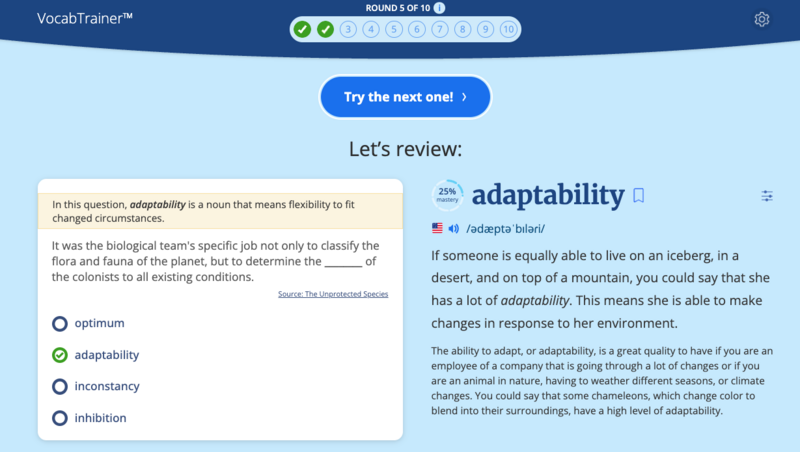
The platform also reflects a basic finding from the field of learning science: Durable knowledge requires more than a single exposure. Through VocabTrainer, students actively retrieve word meanings, receive immediate feedback, and encounter words in varied questions and contexts. Its adaptive system directs practice toward words each learner is ready to study and revisits words that still need work. Repeated retrieval strengthens access to word meanings, so students are more likely to recognize and understand those words when they appear in authentic reading.
That growing store of readily accessible word knowledge supports literacy in several ways: It reduces the number of meaning gaps that interrupt comprehension; helps students interpret an author’s tone and word choice; and gives them more precise language for speaking and writing. Students’ word-learning data provided by Vocabulary.com helps educators identify words that need additional instruction, making practice responsive rather than one-size-fits-all.
Vocabulary.com can also support morphology instruction, another research-based route to stronger literacy. Its collections devoted to roots, prefixes, and suffixes help students analyze meaningful word parts and recognize relationships among words. Research shows that morphology instruction can strengthen vocabulary and other literacy skills. For example, a reader who knows that circum means “around” and locution relates to speaking can infer that circumlocution means using an indirect, roundabout way of expressing something. Instead of memorizing every unfamiliar word in isolation, students learn to use meaningful word parts to make informed predictions as they read.
Building a Life with Words
Building a strong vocabulary is an ongoing process. Through direct instruction, wide reading, rich conversation, and frequent opportunities to use new language, learners develop word knowledge that deepens comprehension and strengthens their ability to communicate. Each new word becomes part of a growing foundation for learning.
That is why vocabulary belongs at the heart of literacy. Words give readers access to stories, explanations, arguments, and ideas. A dictionary opens the door to a word; well-designed practice helps the learner carry that word into the next book and the next conversation. When we help learners build lasting word knowledge, we give them greater access to everything reading makes possible.
